STA 0+30 · Tank care
Septic Tank Inspections
A look at the tank, the baffles, the distribution box and the drain field, from the crew in Selah that serves Yakima, Ellensburg and the Tri-Cities.
Chapter 01
What an inspection is there to catch
A septic system does not announce itself until something is already wrong. A hairline crack in a tank wall, a corroded fitting, a baffle that has let go at the inlet or the outlet: none of it shows from the lawn. The first sign is usually soggy ground or a smell over the field, and by then the drain field is already taking the damage.
That is the whole reason to look early. An inspection finds the part that is failing while it is still a repair, not a replacement field. It also turns up the quieter problems, like a distribution box that has shifted or a tank that has been leaking for a while without anyone knowing.
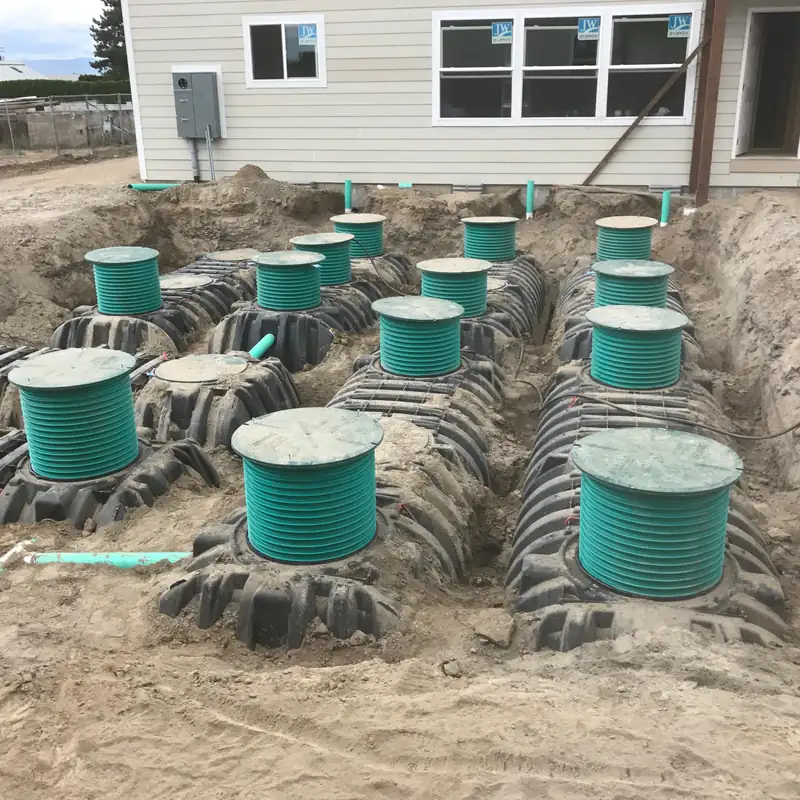
Green riser lids and rows of drainfield chambers set in fresh dirt beside a house
How we work through the system
We start with a visual inspection of the tank and its parts. That means checking for signs of leaks, cracks, corrosion or damage to the tank itself, then the inlet and outlet baffles, then the distribution box if the system has one.
Then we walk out to the drain field. Saturation, pooling water and foul odors near the field are the signs that the soil is not absorbing effluent the way it should. When the tank looks fine but the field does not, that tells you where the real work is. Wyatt runs the camera on the diagnostic side, and a Google reviewer, Kim Cook, wrote that Natasha is present at inspections. Call (509) 367-3384 to book one.
Chapter 03
A plan for the years after
An inspection ends with a maintenance plan, not just a verdict. It sets out recommended pumping intervals and the other tasks that keep the system in good working order, written for your tank and your household.
As a general guide, tanks should be inspected regularly, typically every 1 to 3 years, depending on tank size, household size and local regulations. Some local authorities require inspections more often, so the plan accounts for what your jurisdiction asks for.
“Wyatt showed up with a camera to go into system.” Kim Cook, Google review. Wastewater Solutions, 412 S 10th St, Selah.
Inspection sheet
What goes on the checklist
Five lines, in the order the water travels. If the sheet turns up a repair, it continues on to septic repairs; if the tank is simply due, the next stop is pumping and cleaning.
Septic tank inspection
Selah, WA
Tank
Leaks, cracks, corrosion or damage to the tank itself.
Inlet and outlet baffles
Both ends looked at, because a failed baffle sends solids toward the field.
Distribution box
Checked wherever the system has one.
Drain field
Saturation, pooling water, or a foul odor over the field.
Maintenance plan
Written up with a recommended pumping interval and the other jobs that keep the system working.