A Homeowner's Guide to the Parts of Your Septic System
Six parts, one path for the water, and a clear idea of which kind of septic work belongs to which part.
October 8, 2026 · 3 min read
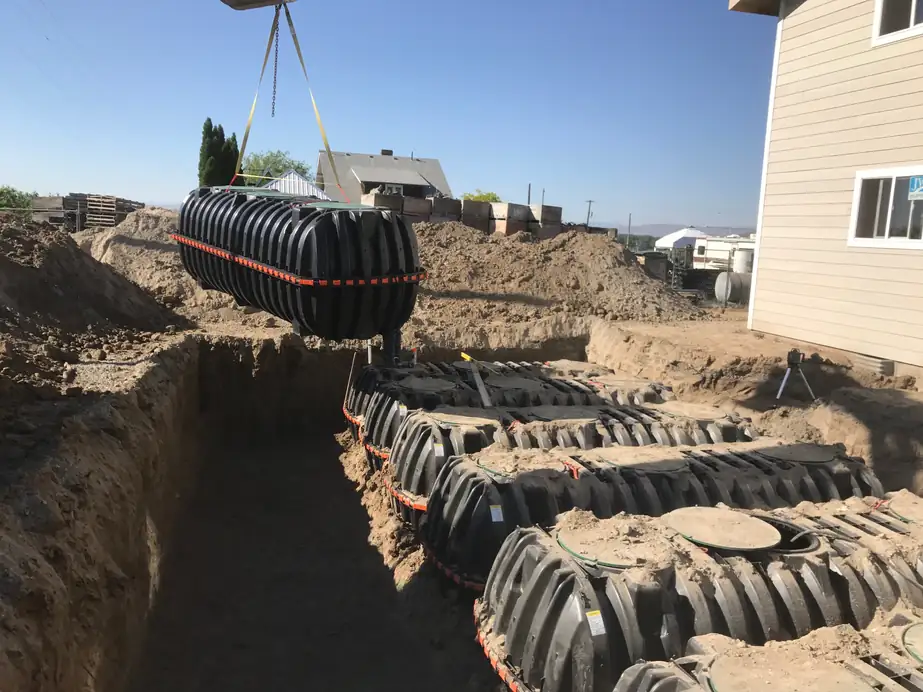
Most septic problems look like a plumbing problem at first. A slow tub, a gurgling toilet, a wet patch in the yard. Once you know the parts of your system and which kind of service work touches each one, it gets a lot easier to describe what you're seeing when you call a septic company. Here's the path your wastewater takes, from the house to the soil.
The house line
Everything starts at the house line, the pipe that carries wastewater out through the foundation or crawlspace. On a gravity system it slopes gently downhill toward the tank. If that pipe has a sag, a crack or a root in it, you can get slow drains and backups inside the house even when the tank and field are fine. Camera work is how a technician sees inside a line without digging. One customer wrote in a Google review that Wyatt showed up with a camera to go into the system and explained everything in easy terms to understand.
The septic tank
The tank is a buried, watertight box, either precast concrete or poly. Wastewater sits in it long enough for the heavy solids to settle to the bottom as sludge, while grease and light material float to the top as scum. The clearer liquid in the middle moves on toward the drainfield. Its access lids are often buried under landscaping near the house, so a lot of owners don't know exactly where theirs are.
Two services belong here. Pumping removes the solids, sludge and scum with a vacuum truck. Inspection looks at the tank itself for leaks, cracks, corrosion and damage. If a tank is beyond repair, replacement means setting a new one, sometimes with a crane when the site is tight.
Baffles, the small parts that matter
Inside the tank are an inlet baffle and an outlet baffle. The inlet baffle sends incoming flow down into the tank so it doesn't churn up the settled layer. The outlet baffle holds scum back so it can't drift out toward the field. When a baffle breaks or rots away, solids can travel into the drainfield, which is one of the faster ways to shorten a field's life. Baffles are on the checklist during an inspection, and repairing or replacing a damaged one is a normal tank repair.
The pump chamber and the distribution box
Not every system has a pump. If the drainfield sits uphill from the tank, or the design calls for pressure distribution, the liquid goes into a pump, either in the tank or in a separate pump chamber. Floats tell the pump when to run, and an alarm warns you about high water. A damaged float switch or a clogged impeller can often be repaired. A burnt-out motor or a badly damaged housing usually means replacement. That's pump repair and replacement work, and it's a different job from pumping the tank.
On a gravity system, the liquid reaches a distribution box instead, which splits the flow evenly among the lines in the drainfield. A box that has settled, cracked or filled with roots sends everything down one line and overloads it. Pressure systems skip the box and use a pump and a network of small laterals, like the ones laid across a sagebrush hillside in some of the local jobs on this site.
The drainfield and the soil under it
The drainfield, also called a leach field, is perforated pipe in gravel trenches or a run of plastic chambers. Liquid from the tank soaks out into the soil, and the soil does the final treatment. That's why the soil test at the start of a project matters so much. Soggy ground, pooling water or a sewage smell near the field means it isn't absorbing what it's being given. Repairs can range from aerating compacted soil to adding lines to replacing the field outright.
Which service touches which part
- House line and plumbing: camera work and a diagnostic inspection.
- Tank and baffles: inspection, pumping, and tank repair or replacement.
- Pump, floats and alarm: pump repair and replacement.
- Distribution box and pipes: repairs, including root removal.
- Drainfield: inspection, repair, or a new field built from a fresh design.
- Whole system on a new lot: site design, permitting and installation.
If you're not sure which part is acting up, that's normal, and it's what a diagnostic visit is for. Call the Selah office at (509) 367-3384 or use the contact page, and tell them what you're seeing and where on the property you're seeing it.
Washington Wastewater Solutions, (509) 367-3384
Call (509) 367-3384More articles
Septic Inspections and Pumping: Setting a Schedule That Fits Your System
An inspection every one to three years tells you what your own tank needs, so pumping stops being a guess.
Septic Warning Signs: What to Do Before and After You Call
Knowing the warning signs and the first few things to do can keep a small septic problem from becoming a big one.